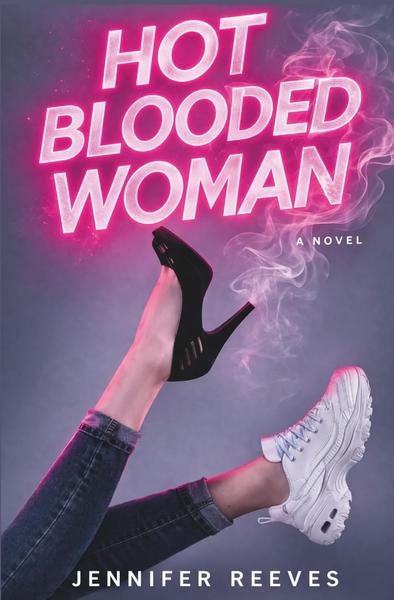
The novel follows Paige, "a young wife in a religious Utah town" who lives the quiet and obedient life she's been raised to conform to. But when her husband leaves on a month-long trip and an old friend resurfaces, Paige's tightly structured life starts to come undone:
"Drawn into a world of forbidden attraction and escalating indulgence ... Paige risks hurting the people who love her most and losing control of herself."
As Jenn
tells us, "a lot of women will see themselves somewhere in these pages."
Read the opening pages at the link above, order your paperback copy, and then while you wait for the mail, check out this Q&A with Jennifer Reeves:
I'm drawing this awesome line straight from your query letter: "As a feminist who's lived my whole life in Utah, I was inspired to write HOT-BLOODED WOMAN by my first-hand experience in the dominating traditional culture and the patriarchal pressures on our young women to marry and fulfill outdated gender roles." My favorite kinds of people are those who turn to fiction when wanting to explore their own
experiences, ideas, etc. But I still like to ask: Why fiction? And which came first, plot or Paige?
I've always had a lot of angst with Utah's culture. Here, women with religious upbringing (which is a lot of us) are all sold the same life plan: graduate high school, go to college (just long enough to meet a man), get married, have babies, then...
well, what else is there?
During my English major, I had a professor talk about some of the "biggest, angriest social novels of their time" and how writers reflect real-world problems through fiction. That stuck with me. I started digging, trying to find more fiction set in Utah. Maybe someone else had captured that angst I'd always felt. Surely someone had
written about a Utah girl who was angry at the world because she took everyone's advice but her own. But the more I looked, the less I found. It didn't exist. And that's when I knew I had my angle.
Hot-Blooded Woman is definitely a reflection of my own experiences, but it's also so much bigger than me. I think a lot of women will see
themselves somewhere in these pages.
At the risk of distracting us so early, I must know what titles you recall from your prof's "biggest, angriest social novels" list! And just to keep us on some kinda track: Would you call HBW an angry novel; and/or Paige an angry
character?
I can't remember all of the novels we talked about but I do remember that Grapes of Wrath, The Age of Innocence, A Farewell to Arms, and The Rise of Silas Lapham were some of them. I'm pretty sure Gatsby and Huck Finn were in there, too. I'll dig into my notes and see what else I've got in there! I adored
that class.
I would not call HBW an angry novel now, but the earliest versions definitely were. The original Paige was more furious and self-destructive. (HBW has been ten years in the making.) The last few revisions I took some of the heaviest elements out because I realized I could still hit the home run and have the story a bit more palatable
for a wider audience. Not only is Paige more likable, but she's more relatable now.
I forgot that you're also a part of the 10-Years Club! Tell us something about the process. The idea hit ten years ago... and then what? Did it sit in your brain, percolating, for a few years? Did you write a draft right away, and if so,
how much of that draft remains? What were all the major steps along the way that got us to this point?
Ha! I didn't know there was such thing as the 10-Years Club, but now I want to hear other 10-years journeys!
I did do a
draft right away. I wrote and finished the book in 2015 and then revised it for another year or two before an endless journey of querying and rejection. Much of the draft remains in the final version in terms of plot and a lot of dialogue. There are two scenes I can think of that have barely changed at all, while others have been heavily edited, deleted or rewritten altogether. When I read the first version now, the bones are all still there and it is recognizable, but the final version is
much, much better. I honestly think that an extra 10 years of growing up and maturing myself had a lot to do with it, too.
I'd been in the querying trenches for years, hoping to land the agent/book deal of my dreams when I had a life-threatening health emergency in late 2024. After I recovered, I realized that I could accomplish being an author on my own. I
rolled up my sleeves, rallied an excellent team of people, and got to work. Everything has been falling into place since and I'm so grateful to have this opportunity and to have my dream finally come true!
The extension of that dream is to find a cool readership. You write that "a lot of women will see
themselves" in Paige. I'm sure you encountered plenty of those agent query forms on QueryTracker or what have you. What type of response would you offer in the "target audience/readership" section? Who should read this book, and why?
Honestly, I think it’s for anyone who’s ever had that quiet, nagging thought—is this it? A lot of women are
taught what their life is supposed to look like, and Paige really leans into that. She does everything right. And then, when she’s finally given a little bit of space, she starts to realize she doesn’t actually know what she wants or who she is outside of that structure.
At its core, it’s really about that question a lot of us don’t say out loud: what if I
want something different? And what happens when you finally let yourself go there. So it’s for readers who are interested in that kind of unraveling. The emotional, uncomfortable, sometimes exciting process of wanting more and whether you’re willing to do anything about it.
The other day you received
your proof copy of the paperback. Can you describe what it was like to open that package, and to hold for the first time this book you've worked on for so long?